
The Great Glen Way, Saturday 1 May 2027
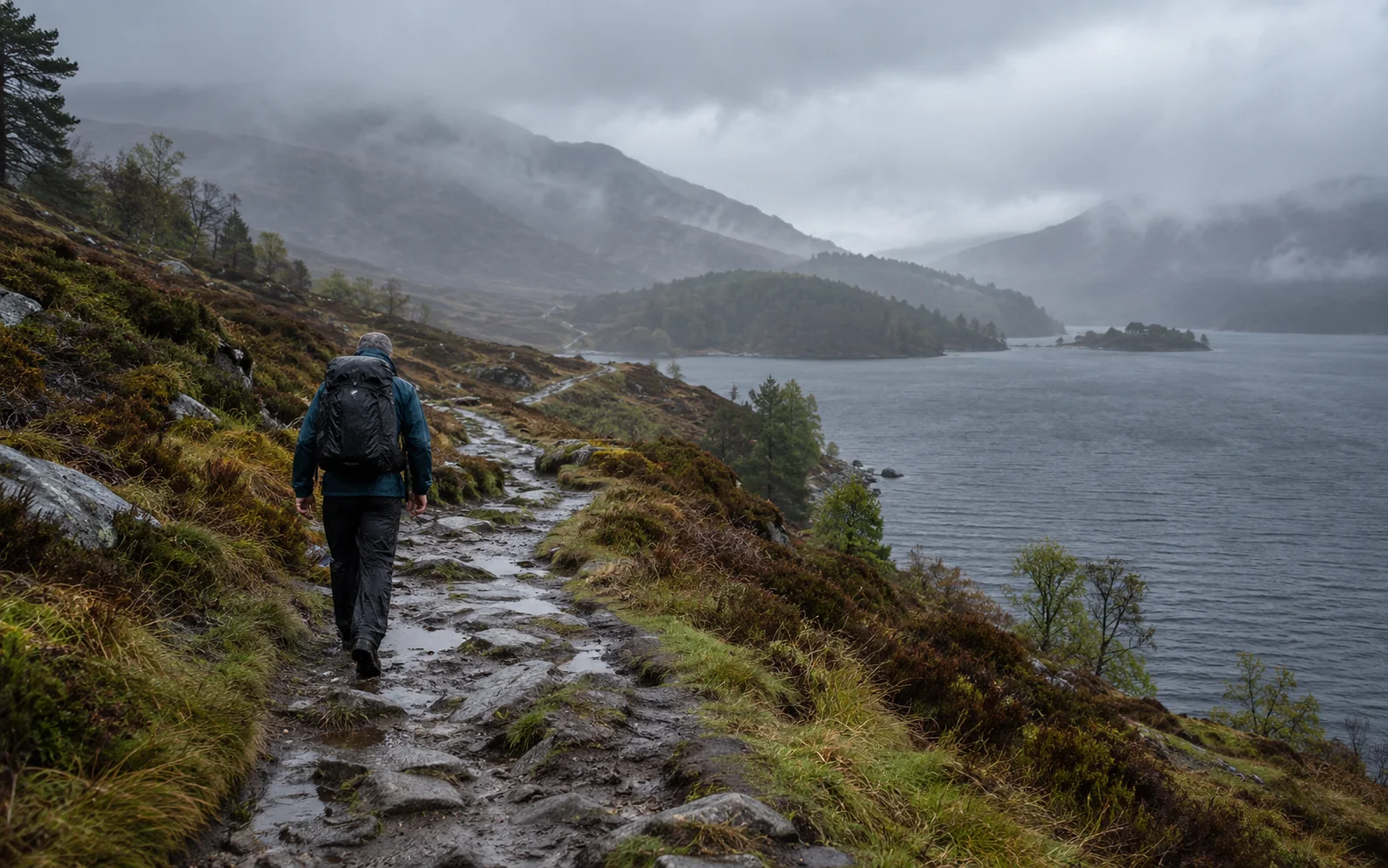
On Saturday 1 May 2027 I am going to set off from Fort William and walk the full Great Glen Way to Inverness. The route is approximately 79 miles / 127 km and the plan is to do it in one continuous effort, so there will be short stops to sort food, feet and whatever else needs dealing with, but no sleep and no big breaks. There is no 24-hour target hidden in there and it is not a race. I will keep moving until I reach Inverness and however long that takes is how long it takes.
Other people are very welcome to get involved as well, actually I’m really hoping they do. Some have said they would like to join a section and a few are interested in attempting the whole route, which they are very welcome to do. I should probably point out that joining for part of it is the sensible option, although I am obviously not in a particularly strong position to lecture anyone about being sensible.
The walking part is quite easy to explain. It is a long way, I will have to train properly for it and at some point it will almost certainly become very, very unpleasant. That is deliberate and it’s not my first rodeo with very long duration events. The bit that has taken me longer to understand is why I seem to ‘need’ something like this sitting in front of me in the first place, and why this particular walk has ended up becoming Project Resilience.
Where this comes from
I have struggled with my mental health for a very long time, probably for longer than I understood at the time and likely all the way back to my childhood. For years I connected almost all of it to the biggest event in my life, which made sense because there is a very obvious before and after, but the older I have got and the more I have looked back at things, the more I have realised it did not actually start there.
I had major problems with self-esteem from quite a young age and there were darker, self-destructive moments long before I would ever have described myself as struggling with my mental health. I can remember being young and drunk in town one night and deliberately putting my head through a window, then telling people afterwards that it had been an accident. It had not been an accident, but I cannot honestly tell you now exactly why I did it. I probably could not have explained it properly then either. I tried to brush it off as me being drunk and doing something stupid, which on one level was true, but looking back there was clearly more going on than I was willing or able to look at. It put me in hospital and should have been a much bigger red flag than it was.
Most of the time I was very good at appearing fine. I could be the clown, have a laugh, always be up for a party and always be searching for the next thing to look forward to. There was far too much drinking, smoking and God knows what else as I got older, and if something a bit darker did appear I would push it away and get on with whatever came next. I did not really think of that as hiding anything because, as far as I was concerned at the time, there was nothing there to hide.
Then in 2002 I caused a car crash that killed my best friend, someone I had grown up with and who had been a huge part of my life. I still find it difficult to write that without wanting to soften it in some way, but there is not really an honest way of doing that. He died because of something I did. Of course I wasn’t the only person whose life changed because of that. His family and everyone else who loved him had to live with what happened too, and I don’t want to lose sight of that when I talk about what followed for me.
I received a prison sentence of three and a half years and served around two. Prison was difficult, as you would expect, but the sentence itself was never the hardest part of it for me. The reason I was there went in with me. The crash added grief, guilt and responsibility to problems that were already there, then prison removed many of the normal distractions I had used to avoid looking too closely at any of them.
I could make what happened next sound much neater than it really was. I went to prison, ‘found’ fitness, started instructing and eventually came out with something I could build a life around. All of those things happened, but it certainly was not some clean turning point where everything suddenly started going in the right direction.
Training helped me massively in prison. At some of my lowest points I shook myself off and simply walked around the perimeter. When allowed I trained in the gym, and when that wasn’t an option it was simple circuits in the cell. By the time I got to a Cat D prison I had gathered enough qualifications to become a gym orderly and started helping people, which gave me a role, some structure and the feeling that I might actually be useful at something. It also gave me somewhere to put some of what was going on in my head.
That did not mean I was talking about it. Prison was not exactly an environment where people were encouraged to openly admit they were struggling. Where I was, being put on suicide watch was often viewed as weakness, so people who probably needed help learned to bury it instead. I did the same and, for quite a long time after I left prison, I still confused keeping going with actually having things under control.
The dragon in the cave
Over the last few years I have started thinking of that darker side of myself as a dragon in a cave. I have no idea exactly where the image came from. I think I saw an animation or film clip somewhere and it just seemed to fit. It has helped me make a bit more sense of how my relationship with it has changed over the years.
Looking back, I think the dragon was already there when I was young. Every now and again it would stir and I would see or feel something I didn’t really understand, then I would do my best to block it again and get on with things. After the crash it became much louder and much harder to ignore. For years my response was to try to control it, force it back down, outwork it or simply stay so busy that I did not have to listen to it. Sometimes that worked for a while, often it didn’t, and it never made it disappear.
“Having a suicidal thought and actually wanting to end your life are not always the same thing.”
I have had suicidal thoughts frequently for a very long time. Around the time of the crash there were periods when, if I’m honest, I think I genuinely did want to act on them. That is not where I am now. I still get the thoughts, but they do not carry the same meaning or urgency they once did. I do not want to die, I would not act on them and I have very strong reasons to stay. I’ve lived with the thoughts long enough that I can recognise them for what they are rather than treating them as something I have to act on.
These days I try to notice when the dragon is stirring rather than wasting so much energy pretending the cave is empty. That does not mean I believe everything going through my head or just let it do what it likes. It means I am more likely to recognise what is happening and do something useful with it before it gets too much of a grip. I am certainly not brilliant at that every time, but I am a lot better at it than I used to be.
There is another part of the analogy that I find harder to explain. I am not even sure that I want to kill the dragon anymore. I definitely do not mean that I enjoy the darker periods, value suicidal thoughts or think any of this is some sort of gift. I do not. The dragon is not my mate and it can still turn on me.
What I mean is that there is an intensity and energy in that part of me and over the years I have often managed to put it somewhere useful. Training, coaching, work, walking, difficult challenges or simply getting myself through periods when things have felt hard. I am not sure I can completely separate the useful energy from the part that can make life bloody difficult, and perhaps trying to completely separate the two is where I went wrong for quite a long time.
I used to think the answer was to beat it, control it or somehow get rid of it completely. Now I think I am trying to notice it sooner, understand it a bit better and decide what I do with it rather than letting it decide for me. That might change again in another ten years, but it is probably the most honest way I can describe it at the moment.
Why make the walk so difficult?
More than twenty years after prison, I am still using many of the same tools I found back then. Training helps, walking helps and having something difficult sitting in the diary seems to give my head somewhere useful to go. There is training to do, kit to sort, routes to work out and problems that need solving. For whatever reason, having that sort of thing in front of me helps.
That is why I want the Great Glen Way to be difficult. Not impossible, just a bit too tough for what I think I can do right now.
I could walk the route over several comfortable days and I am sure it would still be a brilliant experience, but it would not give me quite the same thing. The continuous effort, walking through the night, being tired and eventually reaching the point where I have had enough but there is still a long way to go are all part of what I am choosing to take on. I do not know exactly how I will feel when I get to that point or how I will respond, and I think that uncertainty is probably part of the attraction.
Both of my SUP attempts did the same sort of thing. They were stupidly long paddles, very hard and they took me into some incredibly tough places mentally, but there was something else in there as well. Something about pushing beyond where I thought I could go and seeing what that exposed.
None of that means I think walking or training fixes mental health. It clearly has not fixed mine. They are tools I have found that help turn the noise down, give me some structure and put some of that energy somewhere positive. Other people will have completely different tools and for some people exercise or putting something difficult in the diary might do absolutely nothing, but I also think there are people for whom it might help and perhaps they will not know until they try.
That does not mean walking 127 km. It might mean getting outside more, lifting weights, running, joining something, having a goal to work towards or finding something else that gives them a bit of focus. I can only really talk about what has helped me, but I do think there is some value in finding out what happens when you deliberately make yourself do something that is a little bit harder than you think you can manage.
For years I thought resilience was mostly about gritting your teeth, getting on with things and refusing to let difficult situations beat you. To be fair, I still believe there is a lot in that. I think there is something important about deliberately doing hard things, getting to the point where your head is telling you that you have had enough and finding out whether you can still take another step. I do not want to lose that side of resilience because it is genuinely important to me.
Where I think I have changed is in believing that resilience also means you have to keep everything buried. Pushing forwards and admitting that you are struggling are not opposites. Talking about something does not automatically make you weak and keeping your mouth shut certainly does not prove that you are coping. I managed to convince myself of that second one for years.
I can acknowledge the dragon, talk about it and use the things that help me while still deliberately putting myself into situations where I have to dig in and keep going. For me, both things are part of resilience.
What Project Resilience is becoming
Project Resilience started mainly because I wanted another difficult challenge. I know from experience that having something big to work towards tends to help me, and walking the Great Glen Way continuously certainly ticks that box.
But the walk also gives us something real to gather around. We can train for it, walk together, people can join parts of the route and conversations can happen while we are actually doing something rather than everyone sitting in a room being told it is time to talk about mental health.
I suspect there are a lot of people with their own version of the dragon, even if they would never call it that and their experience looks nothing like mine. They go to work, raise children, train, see friends, laugh and appear completely fine from the outside while dealing with something very different when nobody else can see it. I did that for years and, to some extent, I probably always will. The difference now is that I am more willing to say what is actually happening.
I certainly do not know what somebody else’s answer is. I am still figuring out parts of my own. Nobody needs to walk 127 km and nobody needs to start telling the world the most difficult parts of their life either. Maybe it is simply saying to one person that things have not been quite right, getting out for a walk with somebody, asking for some help or finding one thing that makes a bad period slightly easier to deal with.
If me talking about my own stuff makes one of those conversations a little easier for somebody else, then that feels worthwhile.
So on Saturday 1 May 2027 I want to dip my hand into the water at Fort William and start walking north towards Inverness. Between now and then I want to get people out on some of the training walks, help anyone mad enough to be considering the whole thing prepare properly and see where this side of Project Resilience goes. I do not particularly want to manufacture the conversations either. Walking alongside somebody for hours has a funny way of creating them naturally.
Then, however many hours after leaving Fort William it eventually turns out to be, I want to reach Inverness and dip that same hand back into the water.
The walk itself is pretty simple in that respect. Start there, finish there and keep moving in between. What Project Resilience becomes around it is less clear, and I think I am actually quite happy with that for now.
We will see.